
. Introduction
A182 F9 is a widely used alloy forged steel grade specified under the ASME SA-182 standard (American Society of Mechanical Engineers), primarily designed for high-temperature and high-pressure (HTHP) service conditions. As a chromium-molybdenum (Cr-Mo) alloy, it exhibits excellent creep resistance, oxidation resistance, and mechanical stability at elevated temperatures, making it a critical material in industries such as oil and gas, power generation, and petrochemical processing. Unlike carbon steels that lose strength at high temperatures, A182 F9 retains structural integrity even in harsh environments, making it suitable for manufacturing pressure-containing components.
2. Material Composition
The chemical composition of A182 F9 is strictly regulated by the ASME SA-182 standard to ensure consistent performance. The key alloying elements and their typical ranges are as follows (by weight percentage):
| Element | Content Range (%) | Function |
| Carbon (C) | 0.15 – 0.25 | Enhances tensile strength and hardness without compromising ductility. |
| Manganese (Mn) | 0.40 – 0.65 | Improves workability and strengthens the material through solid-solution strengthening. |
| Silicon (Si) | 0.50 Max | Acts as a deoxidizer during manufacturing and boosts oxidation resistance. |
| Chromium (Cr) | 8.00 – 10.00 | The primary alloying element; forms a protective oxide layer to resist oxidation and corrosion at high temperatures. |
| Molybdenum (Mo) | 0.90 – 1.10 | Enhances creep strength and high-temperature stability, critical for HTHP applications. |
| Phosphorus (P) | 0.025 Max | Controlled to minimize brittleness, especially in low-temperature environments. |
| Sulfur (S) | 0.025 Max | Restricted to avoid reducing ductility and weldability. |
This composition balances strength, ductility, and corrosion resistance, making A182 F9 a versatile choice for demanding industrial applications.
3. Mechanical Properties
A182 F9’s mechanical properties are validated through standardized testing, with requirements tailored to ensure reliability in HTHP service. The following values represent typical room-temperature and high-temperature performance (per ASME SA-182):
3.1 Room-Temperature Properties
- Tensile Strength (UTS): Minimum 620 MPa (90 ksi)
- Yield Strength (0.2% Offset): Minimum 415 MPa (60 ksi)
- Elongation: Minimum 20% (in 50 mm gauge length)
- Reduction of Area: Minimum 40%
- Impact Toughness (Charpy V-Notch): Minimum 27 J (20 ft-lb) at -29°C (-20°F)
3.2 High-Temperature Properties
A182 F9’s standout feature is its retention of strength at elevated temperatures. For example:
- At 540°C (1000°F): Yield strength remains above 275 MPa (40 ksi), and tensile strength above 485 MPa (70 ksi).
- Creep Resistance: Exhibits minimal deformation under long-term stress at high temperatures (e.g., <0.1% creep strain after 10,000 hours at 550°C and 150 MPa).
4. Heat Treatment Requirements
Heat treatment is critical to optimizing A182 F9’s microstructure and mechanical properties. The standard specifies the following process:
- Normalization: Heat the material to 890 – 940°C (1635 – 1725°F), hold for a sufficient time to ensure uniform heating, then air-cool. This step refines the grain structure and transforms the steel into austenite.
- Tempering: Reheat the normalized material to 675 – 760°C (1250 – 1400°F), hold for 1 – 2 hours, then air-cool. Tempering reduces brittleness, stabilizes the microstructure (forming tempered martensite or bainite), and balances strength and toughness.
Post-weld heat treatment (PWHT) is also recommended for A182 F9 components (e.g., welds in valves or flanges) to relieve residual stresses and prevent cracking. Typical PWHT parameters include heating to 650 – 700°C (1200 – 1290°F) and holding for 1 – 4 hours.
5. Typical Applications
A182 F9 is widely used in components that operate under HTHP and corrosive conditions. Key applications include:
- Oil and Gas Industry: Forged flanges, valves, and fittings in hydrocracker systems, wellheads, and pipeline pressure vessels (resists hydrogen attack and sulfur corrosion).
- Power Generation: Boiler tubes, turbine casings, and steam headers in coal-fired or nuclear power plants (withstands high-temperature steam and thermal cycling).
- Petrochemical Industry: Reactors, heat exchangers, and process piping for ethylene cracking and refinery processes (resists oxidation and chemical erosion).
- Chemical Processing: Pressure vessels and pumps handling corrosive fluids at elevated temperatures (e.g., acidic or alkaline solutions).
5.1 Specific Product Types
Leveraging its high-temperature strength, creep resistance, and forgeability, A182 F9 is fabricated into various industrial products, with designs optimized for HTHP service:
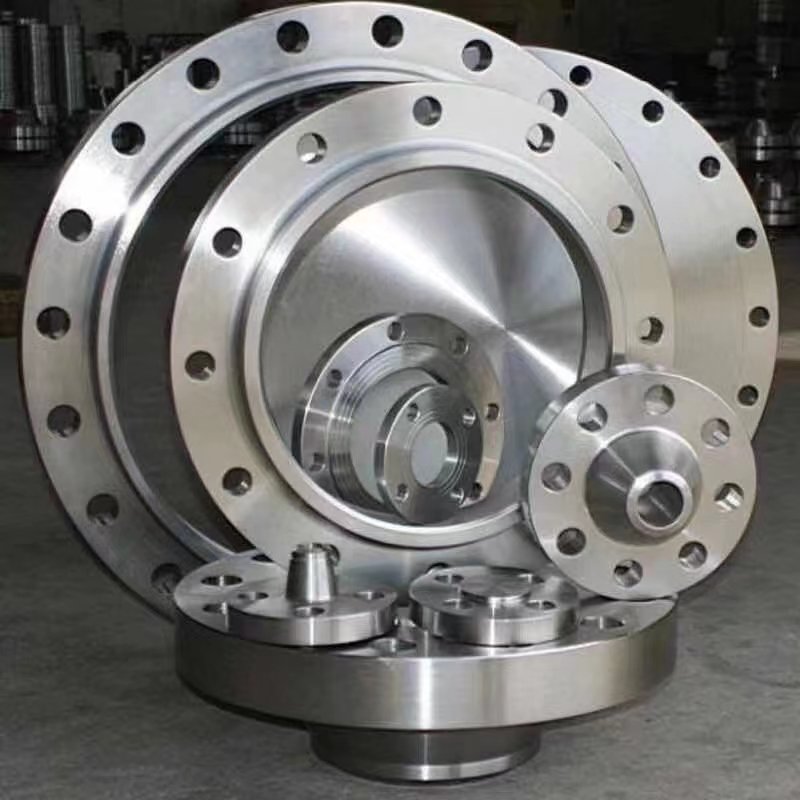
- Forged Flanges: Including weld neck flanges, slip-on flanges, and blind flanges (per ASME B16.5 standard), used to connect pipes, valves, and pressure vessels. The material’s high tensile strength ensures tight sealing and structural stability under pressure (up to Class 2500 for high-pressure systems).
- Valve Components: Valve stems, valve discs, and valve bodies for gate valves, globe valves, and check valves. These parts require resistance to wear, thermal fatigue, and media corrosion—properties A182 F9 delivers through its Cr-Mo alloy composition.
- High-Pressure Fittings: Elbows, tees, reducers, and couplings for process pipelines. Forged construction (a core advantage of A182 grades) eliminates internal defects, making these fittings suitable for transporting high-temperature hydrocarbons or steam.
- Stud Bolts and Nuts: Heavy-duty fasteners for securing flanges or pressure vessel covers. A182 F9’s yield strength and creep resistance prevent bolt relaxation under long-term HTHP service, avoiding leakage risks.
- Reactor Internals: Forged baffles, support rings, and nozzle necks in hydroprocessing reactors. These components endure continuous exposure to high-temperature hydrogen and catalyst particles, where A182 F9’s oxidation resistance and structural integrity are critical.
- Heat Exchanger Tubesheets: Thick forged plates that support heat exchanger tubes. The material’s uniform microstructure (achieved via controlled heat treatment) ensures compatibility with tube welding and resistance to thermal stress from fluid temperature variations.
6. Advantages and Limitations
6.1 Key Advantages
- Excellent High-Temperature Performance: Outperforms carbon steels and low-alloy steels in creep resistance and oxidation resistance.
- Good Weldability: Can be welded using conventional processes (e.g., GTAW, SMAW) with proper preheating (150 – 250°C) and PWHT.
- Cost-Effective: Offers better high-temperature properties than stainless steels (e.g., 304, 316) at a lower cost, making it a cost-efficient choice for HTHP applications.
6.2 Limitations
- Not Suitable for Severe Corrosion: Cannot withstand highly acidic or chloride-rich environments (e.g., seawater) without additional coatings (e.g., chrome plating).
- Sensitivity to Over-Tempering: Exceeding the recommended tempering temperature may reduce strength, requiring strict process control.
7. Quality Control and Standards Compliance
To ensure reliability, A182 F9 components must comply with ASME SA-182 requirements, including:
- Chemical composition analysis (via spectrometry or wet chemistry).
- Mechanical testing (tensile, impact, and hardness tests).
- Non-destructive testing (NDT): Ultrasonic testing (UT) for internal defects, magnetic particle testing (MT) or liquid penetrant testing (PT) for surface defects.
- Traceability: Each component must be marked with the grade (F9), heat number, and manufacturer’s identification for quality tracking.
8. Conclusion
A182 F9 is a high-performance Cr-Mo alloy forged steel that plays a vital role in HTHP industrial applications. Its balanced chemical composition, excellent mechanical properties, and cost-effectiveness make it a preferred material for pressure-containing components in oil and gas, power, and petrochemical sectors. By adhering to strict heat treatment processes, quality control measures, and ASME standards, A182 F9 components—from flanges to reactor internals—ensure long-term reliability and safety in harsh operating environments. As industrial demands for higher temperatures and pressures grow, A182 F9 will continue to be a key material in advancing energy and chemical processing technologies.