
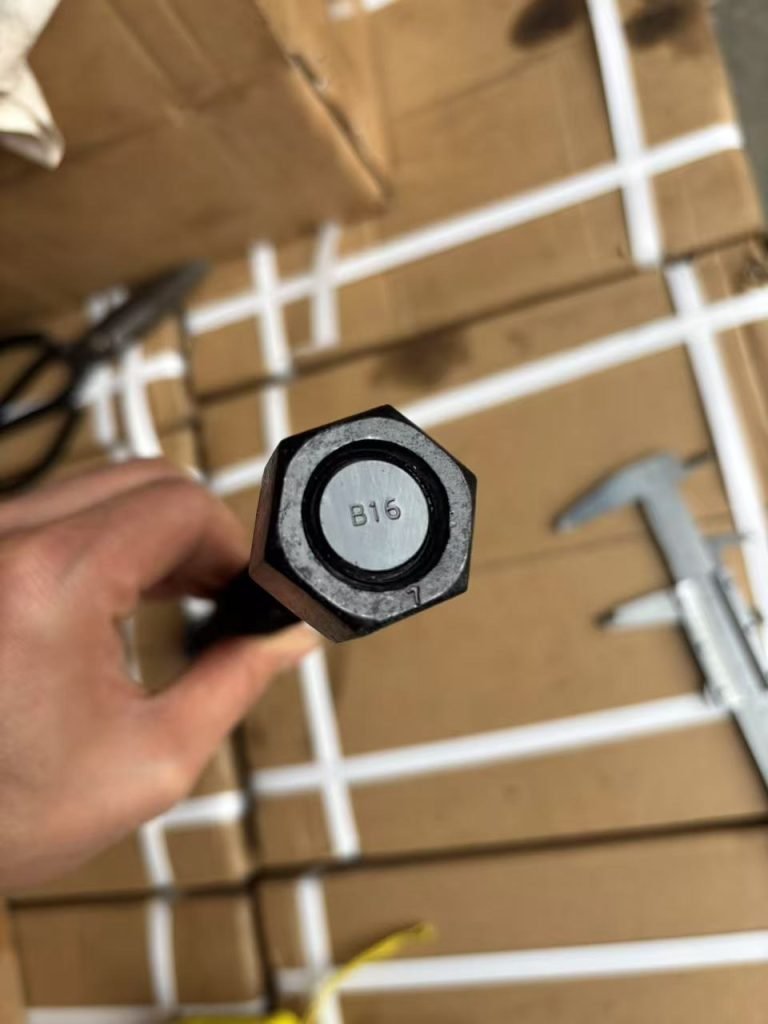
B16 Bolts (ASTM A193 Standard) Technical Specifications
1. Overview
B16 bolts are high-performance alloy steel fasteners manufactured in compliance with ASTM A193 standards, ensuring exceptional stability and strength in extreme operating conditions 1.
2. Chemical Composition
High-Temperature & High-Pressure Bolts/Studs ASTM A193 B16
ASTM A193 B16 bolts/studs are chromium-molybdenum-vanadium (Cr-Mo-V) alloy steel fasteners designed for pressure vessels, valves, flanges, and pipe fittings in extreme service conditions 1.
Chemical Composition (ASTM A193 B16 Grade):
Molybdenum (Mo): 0.50–0.65%
Carbon (C): 0.36–0.44%
Silicon (Si): 0.15–0.35%
Manganese (Mn): 0.45–0.77%
Phosphorus (P): ≤0.025%
Sulfur (S): ≤0.025%
Chromium (Cr): 0.80–1.15%
Nickel (Ni): ≤0.30%
Copper (Cu): ≤0.30%
Vanadium (V): 0.25–0.35%
- Material: Chromium-Molybdenum-Vanadium alloy steel (e.g., 40Cr2MoV)
- Key Elements: Carbon (C), Manganese (Mn), Phosphorus (P), Sulfur (S), Silicon (Si), Chromium (Cr), Molybdenum (Mo), and Vanadium (V) 2.
- Benefits: Precise alloy ratios deliver superior tensile strength, yield strength, and resistance to high temperatures and corrosion 3.
3. Mechanical Properties
- Tensile Strength: High, with an optimized yield-to-tensile ratio for heavy loads.
- Hardness: ~302 HB (33 HRC) after tempering, ensuring stability under high-pressure and high-temperature (HPHT) conditions 4.
- Heat Treatment: Quenched (1700–1750°F / 925–955°C) and tempered to enhance mechanical properties and minimize relaxation 5.
4. Applications
- Petrochemical: Critical for pipeline flanges, valve assemblies, and high-pressure systems due to corrosion resistance.
- Energy Sector: Preferred in power plants (thermal/nuclear) for withstanding thermal stress and creep.
- Heavy Machinery: Full-thread designs facilitate efficient assembly/disassembly of load-bearing components 6.
5. Standard Specification
ASTM A193/A193M-2017 is the governing standard for high-temperature/high-pressure fastener materials, including Grade B16 chromium-molybdenum-vanadium alloy steel 1.
6. Heat Treatment Requirements
- Strict Process Control: Mandatory quenching (1700–1750°F / 925–955°C) and tempering to optimize mechanical properties 2.
- Hardness Limit: ≤ 35 HRC (max) to prevent brittleness in service 3.
7. Mechanical Properties
- Tensile Strength: ≥ 860 MPa (125 ksi) 4.
- Yield Strength: ≥ 720 MPa (105 ksi, 0.2% offset) 4.
- Ductility: Minimum 16% elongation in 4D and 50% reduction of area 4.
8. Additional Testing
- Charpy V-Notch Impact Test: Required for critical applications (e.g., cryogenic or high-stress environments) 5.
- Metallurgical Inspection: Grain size and phase distribution must comply with ASTM A193