
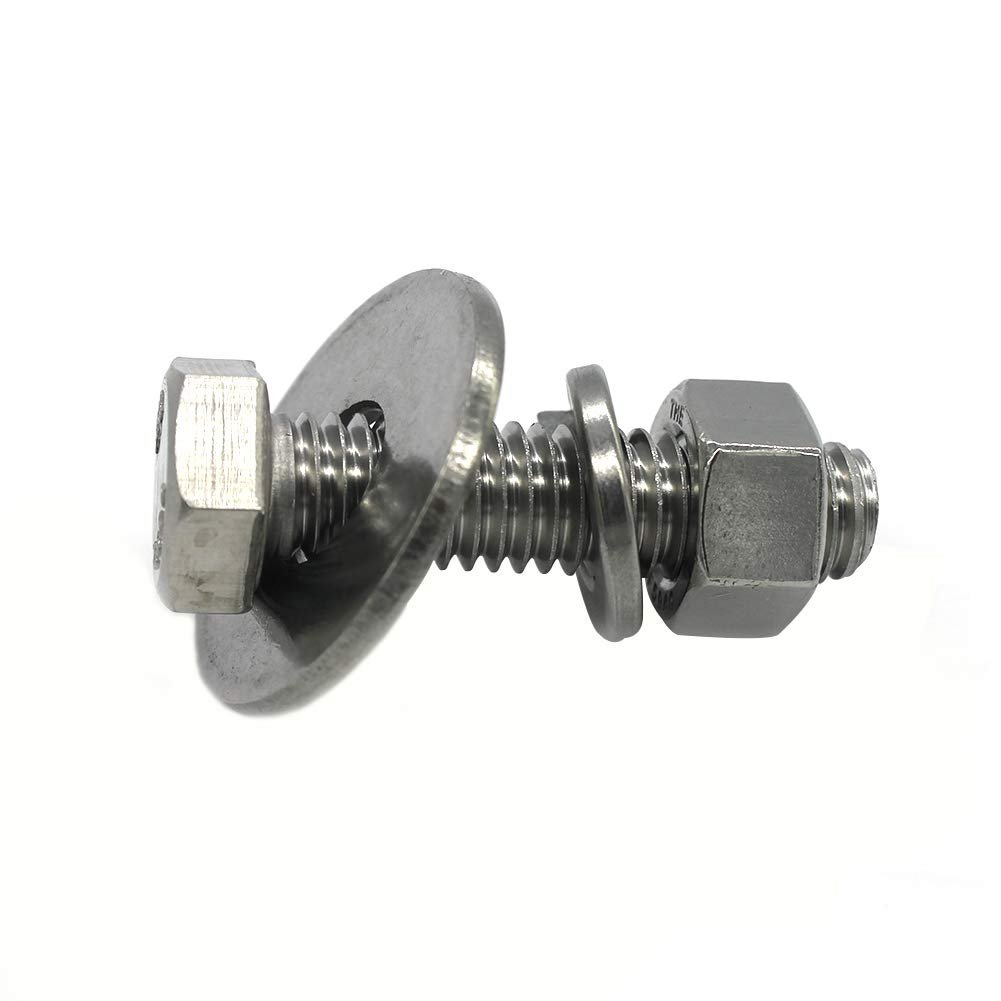
Overview of ASTM A193 Grade B8T
ASTM A193 Grade B8T is a high-performance material specification for externally threaded fasteners—including bolts, screws, stud bolts, anchor bolts, and threaded rods—manufactured from 321 (or 321H) austenitic stainless steel. Designed for demanding applications requiring high tensile strength, excellent corrosion resistance, and thermal stability, it is widely used in pressure piping, pressure vessels, and high-temperature industrial systems. What sets Grade B8T apart is its titanium (Ti) alloying, which enhances resistance to intergranular corrosion and creep at elevated temperatures, making it a reliable choice for critical engineering environments.
This specification defines strict requirements for chemical composition, mechanical properties, heat treatment, and hardness, ensuring consistency and performance across all compliant fasteners. It is further categorized into two tensile classes—Class 1 and Class 2—each tailored to specific strength and ductility needs.
Key Tensile Classes: Class 1 vs. Class 2
ASTM A193 Grade B8T fasteners are distinguished by two tensile classes, differing primarily in heat treatment processes and resulting mechanical performance:
| Tensile Class | Heat Treatment Process | Core Characteristics |
|---|---|---|
| Class 1 | Carbide Solution Treated | Optimized for ductility and corrosion resistance; no additional work hardening |
| Class 2 | Carbide Solution Treated + Strain Hardened | Enhanced tensile and yield strength via cold working; balanced durability for high-load applications |
Critical Notes on Heat Treatment
- Carbide Solution Treatment: Involves heating the 321 stainless steel to 1010–1120°C, followed by rapid cooling. This process dissolves precipitated carbides, preserving corrosion resistance and structural uniformity.
- Strain Hardening (Class 2 Exclusive): Cold working post-solution treatment introduces controlled plastic deformation, increasing strength by refining the material’s grain structure—ideal for high-pressure or vibration-prone environments.
Chemical Composition of ASTM A193 Grade B8T (321/321H Stainless Steel)
The chemical composition of ASTM A193 Grade B8T adheres to strict limits to ensure optimal performance. Intentional addition of bismuth (Bi), selenium (Se), tellurium (Te), or lead (Pb) is prohibited.
| Element | Composition Range (%) | Role in Performance |
|---|---|---|
| Carbon (C) | Maximum 0.08 | Controls strength; low content minimizes carbide precipitation |
| Manganese (Mn) | Maximum 2.00 | Improves workability and tensile properties |
| Phosphorus (P) | Maximum 0.045 | Restricted to avoid brittleness |
| Sulfur (S) | Maximum 0.030 | Minimized to enhance corrosion resistance and ductility |
| Silicon (Si) | Maximum 1.00 | Aids in deoxidation during manufacturing |
| Chromium (Cr) | 17.00 – 19.00 | Forms a protective oxide layer for corrosion resistance |
| Nickel (Ni) | 9.00 – 12.00 | Stabilizes the austenitic structure for thermal and mechanical consistency |
| Titanium (Ti) | 5×Carbon Content – 0.70 | Prevents intergranular corrosion by binding with carbon |
| Nitrogen (N) | Maximum 0.10 | Enhances tensile strength without compromising ductility |
Mechanical Properties of ASTM A193 Grade B8T
Mechanical requirements vary by tensile class and fastener diameter, with Class 2 delivering superior strength due to strain hardening. All values below meet ASTM A193 standard specifications:
| Tensile Class | Diameter (Inch) | Minimum Tensile Strength (ksi) | Minimum Yield Strength (0.2% offset, ksi) | Minimum Elongation (in 4D, %) | Minimum Reduction of Area (%) | Maximum Hardness |
|---|---|---|---|---|---|---|
| Class 1 | All Sizes | 75 | 30 | 30 | 50 | 223 HBW / 96 HRB |
| Class 2 | 3/4 and Under | 125 | 100 | 12 | 35 | 321 HBW / 35 HRC |
| Class 2 | Over 3/4 to 1 | 115 | 80 | 15 | 35 | 321 HBW / 35 HRC |
| Class 2 | Over 1 to 1-1/4 | 105 | 65 | 20 | 35 | 321 HBW / 35 HRC |
| Class 2 | Over 1-1/4 to 1-1/2 | 100 | 50 | 28 | 50 | 321 HBW / 35 HRC |
Important Consideration for Large Diameters
For Class 2 fasteners with diameters of 1-1/2 inches and above, core (center) mechanical properties may be lower than values measured at 1/2 radius (as reported in test certificates). This is a normal result of the strain hardening process for larger cross-sections.
Recommended Nuts & Washers for ASTM A193 Grade B8T
To ensure compatibility and performance, ASTM A193 Grade B8T fasteners should be paired with nuts and washers that match their corrosion resistance and temperature tolerance:
- Nuts: ASTM A194 Grade 8T (321 stainless steel) nuts—engineered to complement Grade B8T’s thermal and chemical resistance.
- Washers: ASTM F436 (hardened steel) or ASTM A434 (321 stainless steel) washers, depending on the application’s corrosion and load requirements.
The main challenge for standard 304 stainless (A193 B8) in the 800°F – 1500°F (427°C – 816°C) range is sensitization. This is when carbon in the steel migrates to the grain boundaries and bonds with chromium, forming chromium carbides. This depletes the chromium—the element that provides corrosion resistance—from the surrounding areas, making the steel susceptible to intergranular corrosion.
The Critical Advantage: Why Choose B8T over B8?
A193 B8T solves this problem. The added Titanium has a stronger affinity for carbon than chromium. The Titanium and Carbon form stable titanium carbides, leaving the chromium in solution to maintain the material’s full corrosion resistance. This makes B8T the superior choice for:
- High-Temperature Service: Where components are exposed to sustained high heat.
- Welded Assemblies: The heat-affected zone (HAZ) from welding can cause sensitization in non-stabilized grades. B8T is resistant to this.
- Cyclic Heating and Cooling: Applications where the fastener repeatedly goes through heating cycles.
Typical Applications of ASTM A193 Grade B8T Fasteners
ASTM A193 Grade B8T excels in environments where high strength, corrosion resistance, and heat stability intersect. Common use cases include:
- Pressure vessels and boilers
- High-temperature piping systems
- Petrochemical and refinery equipment
- Power generation (nuclear, thermal, and renewable)
- Aerospace and automotive high-heat components
- Industrial machinery operating at 500°C+
Conclusion: The Assurance of Performance
Specifying ASTM A193 B8T is more than a line item on a bill of materials; it is a commitment to safety, reliability, and longevity. When your application involves high temperatures, corrosive media, or welding, the titanium-stabilized assurance of Grade B8T provides the critical performance needed to prevent costly downtime and dangerous failures.
For engineers and project managers who cannot afford compromise, A193 B8T represents the proven, industry-standard solution for high-performance stainless steel bolting.