
Introduction
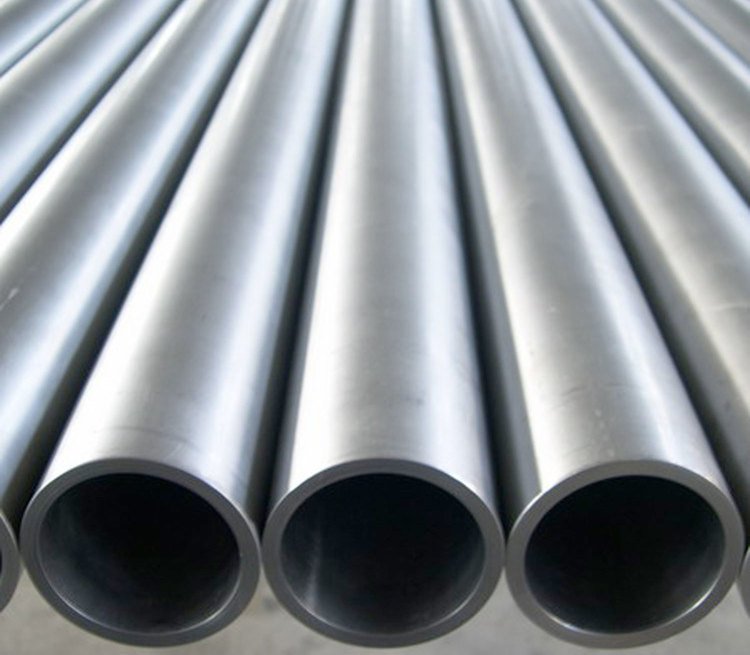
Alloy 690 is a high-chromium nickel alloy that exhibits excellent resistance to many corrosive aqueous media and high temperature environments. It has good fabrication characteristics, metallurgical stability and high strength.
However, the alloy shows excellent resistance to stress-corrosion cracking and low corrosion rates under various high-temperature solutions.
The following datasheet will provide more details about alloy 690.
Chemical Composition
The following table shows the chemical composition of alloy 690.
| Element | Content (%) |
|---|---|
| Nickel, Ni | ≥58 |
| Chromium, Cr | 27-31 |
| Iron, Fe | 7-11 |
| Copper, Cu | 0.5 |
| Manganese, Mn | ≤0.5 |
| Silicon, Si | ≤0.5 |
| Sulfur, S | ≤0.15 |
| Carbon, C | ≤0.05 |
Physical Properties
The physical properties of alloy 690 are outlined in the following table.
| Properties | Metric | Imperial |
|---|---|---|
| Density | 8.19 g/cm³ | 0.296 lb/in³ |
Mechanical Properties
The mechanical properties of alloy 690 are outlined in the following table.
| Properties | Metric | Imperial |
|---|---|---|
| Tensile strength | 724 MPa | 105000 psi |
| Yield strength (@strain 0.2%) | 348 MPa | 50500 psi |
| Modulus of elasticity | 211 GPa | 30600 ksi |
| Shear modulus | 81.8 GPa | 11900 ksi |
| Poisson’s ratio | 0.289 | 0.289 |
| Elongation at break | 41% | 41% |
Thermal Properties
The thermal properties of alloy 690 are given in the following table.
| Properties | Metric | Imperial |
|---|---|---|
| Thermal expansion coefficient (@24-100°C/75.2-212°F) | 14.06 µm/m°C | 7.8 µin/in°F |
| Thermal conductivity | 13.5 W/mK | 93.7 BTU in/hr.ft².°F |
Manufacturing Process
Alloy 690 is readily fabricated using conventional techniques used for high-nickel alloys. This alloy is not hardenable by heat treatment, and it is normally used in the annealed condition.
It exhibits excellent weldability, and it can be welded using filler metals and welding electrode. The temperature range for heavy hot forming of alloy 690 is 1040 to 1230°C (1900 to 2250°F). Light forming can be done at temperatures down to 870°C (1600°F).
Applications
The following are some of the major applications of alloy 690:
- Tail-gas reheaters used in nitric acid production
- Coal-gasification units
- Glass vitrification equipment for radioactive waste disposal
- Incinerators
- Furnaces for petrochemical processing
- Burners and ducts for processing sulfuric acid