
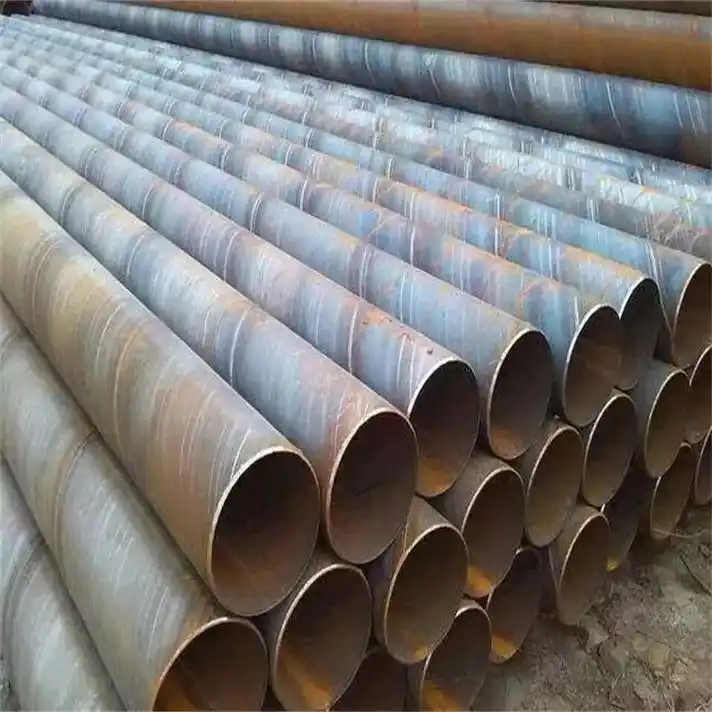
1. Manufacturing Process
- Spiral Welded Pipe (SSAW/HSAW):
- Formed by continuously feeding a steel strip (skelp) at an angle onto a forming machine.
- The strip is helically wound into a cylindrical shape with a consistent spiral seam.
- The seam is welded (typically using Submerged Arc Welding – SAW) in a continuous spiral along the pipe’s entire length.
- The weld angle relative to the pipe axis is typically between 15° and 75°.
- Longitudinal Welded Pipe (LSAW/ERW):
- LSAW: Formed by bending and shaping a single steel plate (skelp) into a “U” then “O” shape (UOE/JCOE processes) or rolling it into a cylinder. The longitudinal seam running parallel to the pipe axis is then welded internally and externally using SAW. Primarily used for larger diameters and thicker walls.
- ERW: Formed by continuously rolling a steel strip into a cylinder. The longitudinal seam is welded by applying high-frequency electrical current to heat and fuse the edges under pressure, without filler metal. Used for a wide range of sizes, typically small to medium diameters.
2. Weld Orientation & Structural Characteristics
- Spiral Welded Pipe:
- Spiral Weld: The weld seam forms a continuous helix around the pipe body.
- Stress Distribution: The spiral weld orientation generally results in a more uniform distribution of stress throughout the pipe wall when subjected to internal pressure. The weld is not perpendicular to the principal hoop stress direction.
- Anisotropy: Can exhibit slightly less directional strength anisotropy compared to straight seam pipes in some cases due to the weld angle.
- Longitudinal Welded Pipe:
- Straight Weld: Features one or two straight weld seams running parallel to the pipe’s longitudinal axis.
- Stress Concentration: Under internal pressure, the hoop stress (the primary stress) acts perpendicularly to the longitudinal weld seam. This can theoretically concentrate stress directly on the weld line.
- Anisotropy: Typically exhibits clear directional strength properties (anisotropy) aligned with the rolling direction of the steel.
3. Diameter and Wall Thickness Capabilities
- Spiral Welded Pipe:
- Diameter: Highly flexible. Can produce pipes over a very wide range of diameters (typically from 6 inches / 150mm up to 120 inches / 3000mm or more) using the same forming equipment by simply adjusting the forming angle. Ideal for large-diameter pipelines.
- Wall Thickness: Generally capable of producing pipes with moderate to thick walls. Practical limitations exist for very thick walls due to forming stresses.
- Longitudinal Welded Pipe:
- LSAW: Primarily designed for large diameters (typically 16 inches / 400mm and above) and heavy wall thicknesses (often exceeding 25mm). Limited by the width of the initial plate/skelp.
- ERW: Best suited for small to medium diameters (typically from 2 inches / 50mm up to 24 inches / 600mm). Capable of producing relatively thin to medium wall thicknesses efficiently. Not ideal for very thick walls or very large diameters.
4. Geometric Tolerances & Straightness
- Spiral Welded Pipe:
- Generally has slightly larger dimensional tolerances (e.g., out-of-roundness, diameter variation) compared to LSAW pipes, especially for thinner walls and large diameters. Can be more prone to curvature or “corkscrewing” if manufacturing control is not optimal.
- Longitudinal Welded Pipe:
- LSAW: Offers excellent dimensional accuracy, tight tolerances (diameter, ovality), and very good straightness due to the controlled forming and sizing processes (UOE/JCOE expansion). Preferred for projects demanding high precision.
- ERW: Also offers good dimensional tolerances and straightness for its typical size range.
5. Material Utilization & Cost Efficiency
- Spiral Welded Pipe:
- Can efficiently use narrower steel coils/strips compared to the wide plates required for large-diameter LSAW pipes. This can offer material cost advantages, especially for large diameters where wide plates are more expensive and less readily available.
- Longitudinal Welded Pipe:
- LSAW: Requires wide steel plates, which can be costlier and have longer lead times, especially for very large diameters/thick walls. Material utilization can be high in modern mills.
- ERW: Highly efficient for small/medium diameters using coiled strip steel.
6. Weld Inspection & Defect Probability
- Spiral Welded Pipe:
- The continuous spiral weld is very long relative to the pipe length. Automated ultrasonic testing (AUT) is standard but requires sophisticated equipment to track the helical path. Theoretically, the continuous nature could mean a defect runs the pipe’s full length if not detected/cut out. Modern mills have excellent controls.
- Longitudinal Welded Pipe:
- LSAW: The straight weld is relatively short. Inspection (AUT, Radiography – RT) is straightforward. Defects are typically localized to the weld seam length.
- ERW: Weld inspection (often eddy current or ultrasonic) is also well-established. The heat-affected zone (HAZ) is narrow.
7. Primary Industrial Applications
- Spiral Welded Pipe:
- Large-diameter, long-distance oil & gas transmission pipelines (onshore & offshore flowlines/risers with appropriate specs).
- Water transmission mains.
- Piling (foundation piles).
- Structural columns/towers.
- Lower-pressure process piping where tolerances are less critical.
- Longitudinal Welded Pipe:
- LSAW: High-pressure oil & gas transmission pipelines (especially offshore, demanding onshore sections), process piping in refineries/petrochemical plants requiring high pressure/temperature rating and precision, large-diameter water intakes/outfalls, structural piles requiring high precision.
- ERW: Oil & gas gathering lines, lower-pressure distribution lines (gas/water), mechanical tubing, structural applications (fencing, scaffolding), fire sprinkler systems, general industrial process piping for smaller lines.
Key Advantages & Disadvantages Summary
| Feature | Spiral Welded Pipe (SSAW/HSAW) | Longitudinal Welded Pipe (LSAW) | Longitudinal Welded Pipe (ERW) |
|---|---|---|---|
| Primary Advantage | Cost-effective large diameters; Flexible diameter production | Superior dimensional precision & strength for large/heavy wall | Efficient & economical for small/medium diameters/thin walls |
| Primary Disadvantage | Larger tolerances; Potential curvature; Weld inspection complexity | Higher material cost (large plates); Limited diameter flexibility | Not suitable for very large diameters or very thick walls |
| Weld Orientation | Spiral (Helical) | Straight (Parallel to axis) | Straight (Parallel to axis) |
| Typical Diameter | Very Wide Range: ~150mm (6″) to 3000mm (120″)+ | Large: ~400mm (16″) and above | Small/Medium: ~50mm (2″) to 600mm (24″) |
| Typical Wall Thickness | Moderate to Thick | Heavy Wall: Often >25mm | Thin to Medium |
| Dimensional Tolerance | Good, but generally larger than LSAW | Excellent (Tightest) | Good |
| Straightness | Good, but potential for corkscrew | Excellent | Good |
| Stress Distribution | More uniform under pressure (weld angle) | Hoop stress perpendicular to weld | Hoop stress perpendicular to weld |
| Material Use | Efficient for large dia (narrow strip/coil) | Requires wide plates (can be costly/scarce) | Efficient (coiled strip) |
| Cost Efficiency | High for Large Diameter | Lower for Large Diameter (plate cost) | High for Small/Medium Diameter |
| Key Applications | Large dia transmission (O&G, Water), Piling, Structural | High-pressure O&G transmission, Critical process piping, Piling | Gathering/distribution lines, Mech. tubing, General process |
Conclusion
The choice between spiral welded (SSAW/HSAW) and longitudinal welded (LSAW/ERW) pipe depends critically on the specific industrial application requirements:
- Spiral Welded Pipe excels as a cost-effective solution for large-diameter applications like transmission pipelines (oil, gas, water), piling, and structural uses where the highest precision tolerances are not the primary driver. Its flexibility in diameter production is a major asset.
- Longitudinal Welded Pipe – LSAW is the preferred choice for high-pressure, critical applications requiring maximum dimensional accuracy, strength, and reliability, especially in large diameters with heavy walls (e.g., offshore pipelines, demanding refinery piping). It commands a premium price.
- Longitudinal Welded Pipe – ERW dominates the market for small to medium diameter piping where efficiency, economy, and good performance for lower-pressure duties are key (e.g., distribution networks, mechanical tubing).