
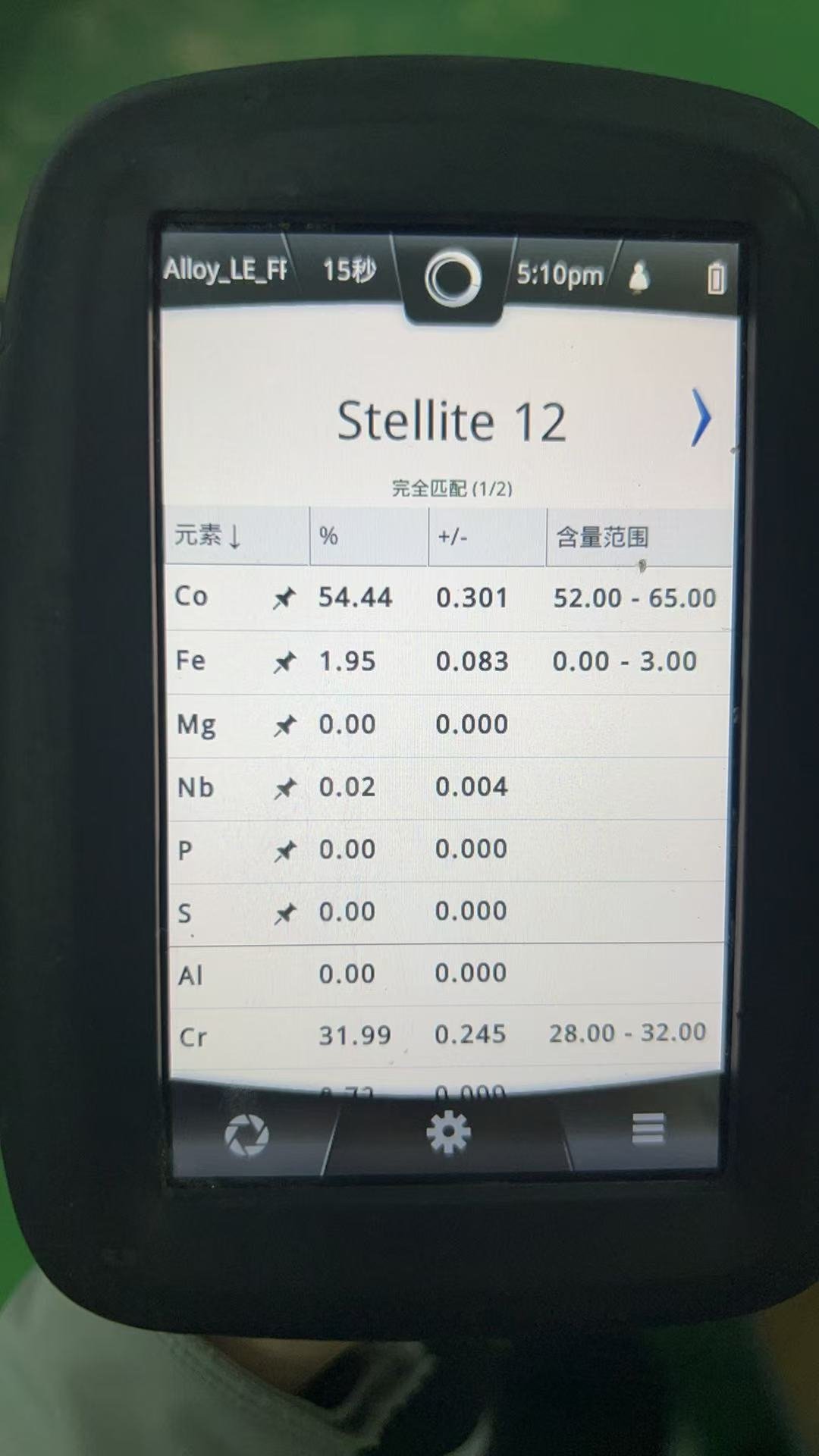
Nominal Composition (Mass %) and Physical Properties
| Co | Cr | W | C | Others | Hardness | Density | Melting Range |
| Base | 27-32 | 7.5-9.5 | 1.4-2.0 | Ni, Fe, Si, Mn | 45-51 HRC 435-590 HV | 8.53 g/cm3 0.308 lb/in3 | 1225-1280ºC 2240-2335ºF |
Chemical Composition: The Foundation of Performance
At its core, Stellite 12 is defined by a precise blend of elements that synergize to deliver its unique characteristics:
- Cobalt (Co): Remaining as the base metal, cobalt provides the alloy with its fundamental structural integrity and resistance to thermal fatigue, typically constituting 50-60% of the composition.
- Chromium (Cr): Comprising 28-32% of the alloy, chromium forms a protective oxide layer on the surface, enhancing oxidation resistance and enabling the material to withstand corrosive environments, including acids and high-temperature gases.
- Tungsten (W): Present at 7.5-9.5%, tungsten contributes to the formation of hard carbides (primarily WC and W₂C), significantly boosting wear resistance and maintaining hardness at elevated temperatures.
- Carbon (C): At 1.1-1.7%, carbon reacts with chromium and tungsten to form chromium carbides (Cr₇C₃) and tungsten carbides, which are dispersed throughout the matrix to reinforce hardness.
- Silicon (Si) and Manganese (Mn): Each limited to ≤1.0%, these elements aid in deoxidation during manufacturing and improve casting fluidity without compromising mechanical properties.
- Iron (Fe): Controlled to ≤3.0% as an impurity, iron is minimized to avoid detrimental effects on corrosion resistance.
This composition creates a microstructure of a cobalt-chromium solid solution embedded with hard carbide particles, balancing toughness with abrasion resistance.
Mechanical and Physical Properties
Stellite 12 exhibits a remarkable combination of properties that make it indispensable in harsh operational environments:
- Hardness: Typically ranges from 44 to 51 HRC at room temperature, retaining approximately 32 HRC even at 700°C (1292°F), outperforming many steels and nickel alloys under thermal stress.
- Tensile Strength: Achieves 1200-1400 MPa in the as-cast condition, with slight variations based on processing methods.
- Wear Resistance: Excels in low-angle erosion, sliding wear, and fretting scenarios, thanks to the hard carbide phase that resists material removal.
- Corrosion Resistance: Performs well in oxidizing atmospheres, weak acids, and saline environments, though it is less suited for strong reducing acids compared to nickel-based alloys like Inconel.
- Temperature Resistance: Maintains structural stability up to 800°C (1472°F), making it suitable for continuous service in high-heat applications such as exhaust systems and industrial furnaces.
Stellite 12
Stellite cobalt-based alloys consist of complex carbides in an alloy matrix. They are resistant to wear, galling, and corrosion and retain these properties at high temperatures. Their exceptional wear resistance is due mainly to the unique inherent characteristics of the hard carbide phase dispersed in a CoCr alloy matrix.
Stellite 12 could be considered an intermediate alloy between Stellite 6 and Stellite 1. It contains a higher fraction of hard, brittle carbides than Stellite 6, and has increased resistance to low-angle erosion, abrasion, and severe sliding wear whilst retaining reasonable impact and cavitation resistance. Stellite 12 is often used self-mated or running against Stellite 6 or Stellite 1. The higher tungsten content provides better high-temperature properties compared to Stellite 6, and it can be used at temperatures up to about 700 ̊C.
Stellite 12 is typically used for cutting tools that need to withstand abrasion, heat, and corrosion. Examples include industrial knives for cutting carpets, plastics, paper and synthetic fibres; and saw tips in the timber industry. It is also used for control plates in the beverage industry, pump vanes, bearing bushes and narrowneck glass mold plungers; and for hardfacing of engine valves, pinch rollers in the metal-processing industries and rotor blade edges.
Stellite 12 can be supplied to the following specifications:
| SPECIFICATION | PRODUCT FORM |
| UNS R30012 | Rod, Castings |
| UNS W73012 | Electrode |
| UNS W73042 | Wire |
| SPECIFICATION | PRODUCT FORM |
| AWS A5.21 / ASME BPVC IIC SF A 5.21 ERCoCr-B | Rod |
| AWS A5.21 / ASME BPVC IIC SF A 5.21 ERCCoCr-B | Wire |
| AWS A5.13 / ASME BPVC IIC SF A 5.13 ECoCr-B | Electrode |
Applications Across Industries
The versatility of Stellite 12 has led to its adoption in diverse sectors:
- Aerospace: Used in turbine engine components, including combustion liners and valve stems, where resistance to high temperatures and oxidation is critical.
- Oil and Gas: Employed in drill bits, valve trim, and wellhead equipment to withstand abrasive drilling fluids and corrosive downhole environments.
- Automotive: Found in exhaust valves and turbocharger parts, benefiting from its ability to resist thermal fatigue and wear under repeated cycles.
- Chemical Processing: Utilized in pumps, mixers, and reactor internals handling corrosive chemicals, where its chromium content provides a protective oxide barrier.
- Tooling and Metalworking: Applied to hot stamping dies, shear blades, and extrusion tools, as its hardness and heat resistance reduce downtime from wear.
Advantages and Limitations
Stellite 12’s strengths lie in its unique balance of properties:
- Advantages: Exceptional wear resistance across a wide temperature range; superior corrosion resistance compared to carbon steels; compatibility with various manufacturing processes; and long service life in harsh conditions.
- Limitations: Higher cost than conventional alloys due to cobalt and tungsten content; relatively low machinability (requiring carbide tools and specialized techniques); and reduced performance in strong reducing environments compared to nickel-based alternatives.