
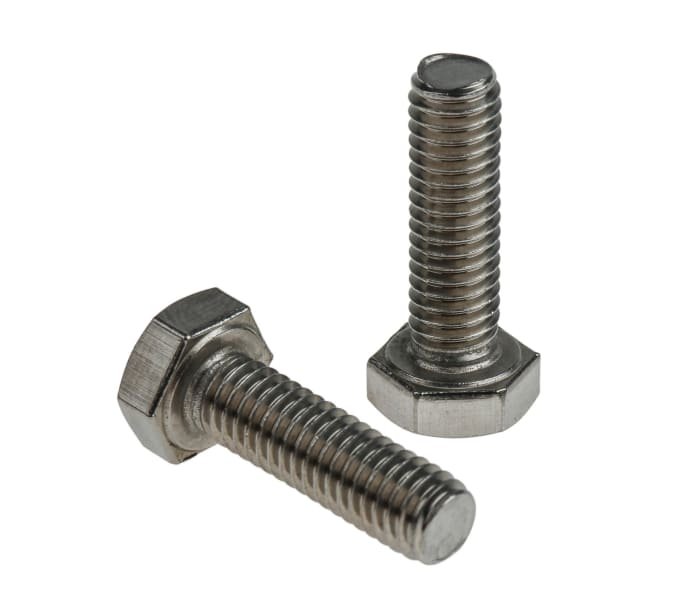
When a bolt has to hold a turbine casing, a high-pressure valve flange or a subsea wellhead together at 600–650 °C for years without loosening, standard 316 or even B7 simply will not survive. That is exactly the service window ASTM A453 Grade 660 was written for. This guide explains what Grade 660 (Alloy A286 / UNS S66286) actually is, how its four classes differ, where engineers specify it, and what to check when you source it — so your procurement team can specify the right class with confidence.
What Is ASTM A453 Grade 660 (Alloy A286 / UNS S66286)?
ASTM A453 / A453M Grade 660 is a specification for iron-based, precipitation-hardening superalloy bolting intended for high-temperature service. In plain terms: it is a special stainless steel that keeps its strength, resists creep, and fights oxidation far beyond where ordinary austenitic grades give up.
The material is better known in the industry by its common trade name Alloy A286, its unified number UNS S66286, and several regional equivalents:
| Designation system | Grade / designation |
| ASTM / ASME | A453 / SA453 Grade 660 |
| Common trade name | Alloy A286, A-286 |
| UNS | S66286 |
| China (GB) | GH2132 |
| Europe (EN) | 1.4980 (X6NiCrTiMoVB25-15-2) |
Its strengthening mechanism is precipitation hardening: the alloy is solution-treated, then age-hardened so that fine gamma-prime (Ni₃Ti / Ni₃Al) particles lock the grain structure. The result is a fully austenitic, non-magnetic material that retains useful strength up to roughly 700 °C and resists oxidation to about 800 °C — a step change above 300-series stainless and Cr-Mo alloys.
Want the exact chemistry, mechanical minimums and heat-treatment tables? See our companion reference: ASTM A453 Grade 660 Class bolts & nuts — full specification tables.
Chemical Composition (UNS S66286)
Grade 660 is a nickel-strengthened, chromium-bearing iron alloy. The controlled composition (weight %) is what gives it both high-temperature strength and corrosion resistance:
| Element | Content (%) |
| Carbon (C) | 0.08 max |
| Manganese (Mn) | 2.00 max |
| Phosphorus (P) | 0.04 max |
| Sulfur (S) | 0.03 max |
| Silicon (Si) | 1.00 max |
| Nickel (Ni) | 24.00 – 27.00 |
| Chromium (Cr) | 13.50 – 16.00 |
| Molybdenum (Mo) | 1.00 – 1.50 |
| Titanium (Ti) | 1.90 – 2.35 |
| Aluminum (Al) | 0.35 max |
| Vanadium (V) | 0.10 – 0.50 |
| Boron (B) | 0.001 – 0.010 |
The high nickel plus titanium/vanadium balance is the heart of the gamma-prime hardening system — and the reason the alloy behaves nothing like a normal 300-series bolt.
Mechanical Properties & Why They Matter at Temperature
At room temperature, Grade 660 delivers roughly:
- Tensile strength: 130 ksi (895 MPa) minimum
- Yield strength: 85 ksi (585 MPa) for Class A/B/C; 105 ksi (725 MPa) for Class D
- Elongation: 15% minimum
- Reduction of area: 18% minimum
- Hardness: 248–341 HBW (with a tighter 35 HRC ceiling where NACE applies)
Those numbers are strong, but the real story is what happens at temperature. Grade 660 is stress-rupture tested in finished condition — Class A/B/C require a minimum 100-hour life at 650 °C (1200 °F) under 56 ksi (385 MPa) load. That is the test that proves a bolt will not slowly creep and fail during years of hot, pressurized service. Standard stainless simply cannot pass it.
The Four Classes: A vs B vs C vs D
This is the part most buyers get wrong. All four classes share the same base alloy, but differ in solution-treatment temperature and aging cycles — which changes which service they suit best.
- Class A — Lower solution temperature (900 °C). Best room-to-moderate-temperature tensile properties and ductility. The default for general pressure-equipment and flange bolting below about 550 °C.
- Class B — Higher solution temperature (980 °C). Optimised for the longest stress-rupture life — the usual choice for sustained service near 650 °C (turbine casings, hot process equipment).
- Class C — Same high solution temperature but oil-quenched and double-aged. Used for heavy sections where a liquid quench would risk cracking, with the same creep intent as Class B.
- Class D — Double-aged high-yield class, raising minimum yield to 725 MPa (105 ksi) and giving the controlled hardness (≤ 35 HRC) required for sour service and API 20F bolting (wellhead, subsea, valve).
Quick selection rule: conventional hot flange or valve below ~550 °C → Class A. Continuous ~650 °C creep-governed service → Class B (or C for heavy sections). Any NACE MR0175 / API 20F sour or subsea requirement → Class D, with the hardness ceiling stated explicitly on the purchase order.
Where Grade 660 Bolting Is Used
Because it holds strength and resists relaxation at temperature, Grade 660 fasteners show up wherever failure is not an option:
- Gas turbines & power generation — turbine casing and combustor-section bolting, superchargers, high-temperature exhaust-manifold fasteners.
- Aerospace & defense — jet-engine components, afterburner structural bolting, rocket-motor housings.
- Nuclear & conventional power — evaporators, pressure-vessel closures, high-pressure flange studs in supercritical units.
- Oil & gas / petrochemical — high-temperature reactors, heaters, hydrotreaters, and HPHT subsea wellhead equipment.
- Industrial furnaces & valves — furnace and kiln hardware, and high-pressure valve bonnet and flange bolting to ASME B16.5 Class 600+.
- Marine & heat exchangers — where bolting must resist both heat and corrosive media.
For the flange bodies these bolts clamp, see our guide to stainless and duplex forged rings and flanges.
Sourcing & Installation Notes
A few practical points that separate a reliable Grade 660 supply from a risky one:
- Match the nut alloy. Grade 660 studs and bolts are normally paired with nuts of the same metallurgy. Mixing with a different alloy risks galvanic corrosion and mismatched thermal expansion during heat cycles.
- Prevent thread galling. Like all austenitic stainless, A286 can cold-weld (gall) under friction. Always apply a quality nickel- or molybdenum-disulfide (MoS₂) anti-seize to threads and bearing faces, and tighten slowly — never with a high-speed impact wrench.
- Demand full documentation. Specify EN 10204 Type 3.1 MTC as a minimum, with chemistry, mechanicals, and — for high-temperature duty — stress-rupture evidence. Where NACE MR0175 / ISO 15156 applies, the hardness ceiling must be verified and recorded.
- Confirm the marking. Finished bolting is marked by class (e.g. BPF 660A / B / C / D) so the grade is unambiguous in the field.
How to Specify & Source Grade 660
As a supplier and stockist of piping and bolting materials rather than a mill, our role is to help you specify the correct class and secure qualified material with full traceability — not to imply we operate a forge. When you request a quote, the details that matter are:
- Class (A/B/C/D) and the service temperature / environment (note any H₂S or sour-service requirement).
- Form and size — stud bolt, hex bolt, heavy hex nut, threaded rod; imperial 3/8″–4″ or metric up to M100, larger by custom order.
- Documentation level — Type 3.1 MTC as standard; Type 3.2 third-party witness for nuclear or offshore packages.
- Certification to standard — ASTM A453 / ASME SA453, cross-referenced to ASTM International and ASME where your project specification demands it.
We consolidate stock and custom Grade 660 bolting with the matching nuts and washers so your team avoids mixed-alloy assemblies, and we qualify material against the relevant standard and, where applicable, AMPP / NACE MR0175 hardness limits.
Why Work With Us for Grade 660 Bolting
We supply ASTM A453 Grade 660 (Alloy A286 / UNS S66286) studs, bolts, heavy hex nuts and threaded rod across all four classes, with EN 10204 3.1 certification and stress-rupture support on qualified orders. Our focus is supply reliability, complete documentation and responsive engineering support — we match the right class to your specification instead of pushing a single source. Browse our full piping and bolting range or contact our team for availability, lead time and pricing on your requirement.
Conclusion
ASTM A453 Grade 660 is the iron-based superalloy of choice when bolting must survive sustained high temperature, creep and corrosive media — from turbine casings to subsea wellheads. The grade itself is fixed; the decision that protects your project is choosing the right class: A for general hot service, B/C for maximum stress-rupture life, and D wherever sour service and API 20F apply. Specify it with full MTC documentation, pair it with same-alloy nuts, and you have a fastener you can trust at temperature.
FAQ
Is ASTM A453 Grade 660 the same as A286? Yes. “Grade 660” is the ASTM A453 designation for the Alloy A286 / UNS S66286 iron-based superalloy. You will see the names used interchangeably.
What is the maximum service temperature? Continuous useful service is around 650 °C (1200 °F), with oxidation resistance extending toward 800 °C. Always confirm the class and stress-rupture basis for your exact duty.
Which class do I need for sour (H₂S) service? Class D, with the NACE MR0175 / ISO 15156 hardness ceiling (≤ 35 HRC) stated on the purchase order and verified on the MTC.