
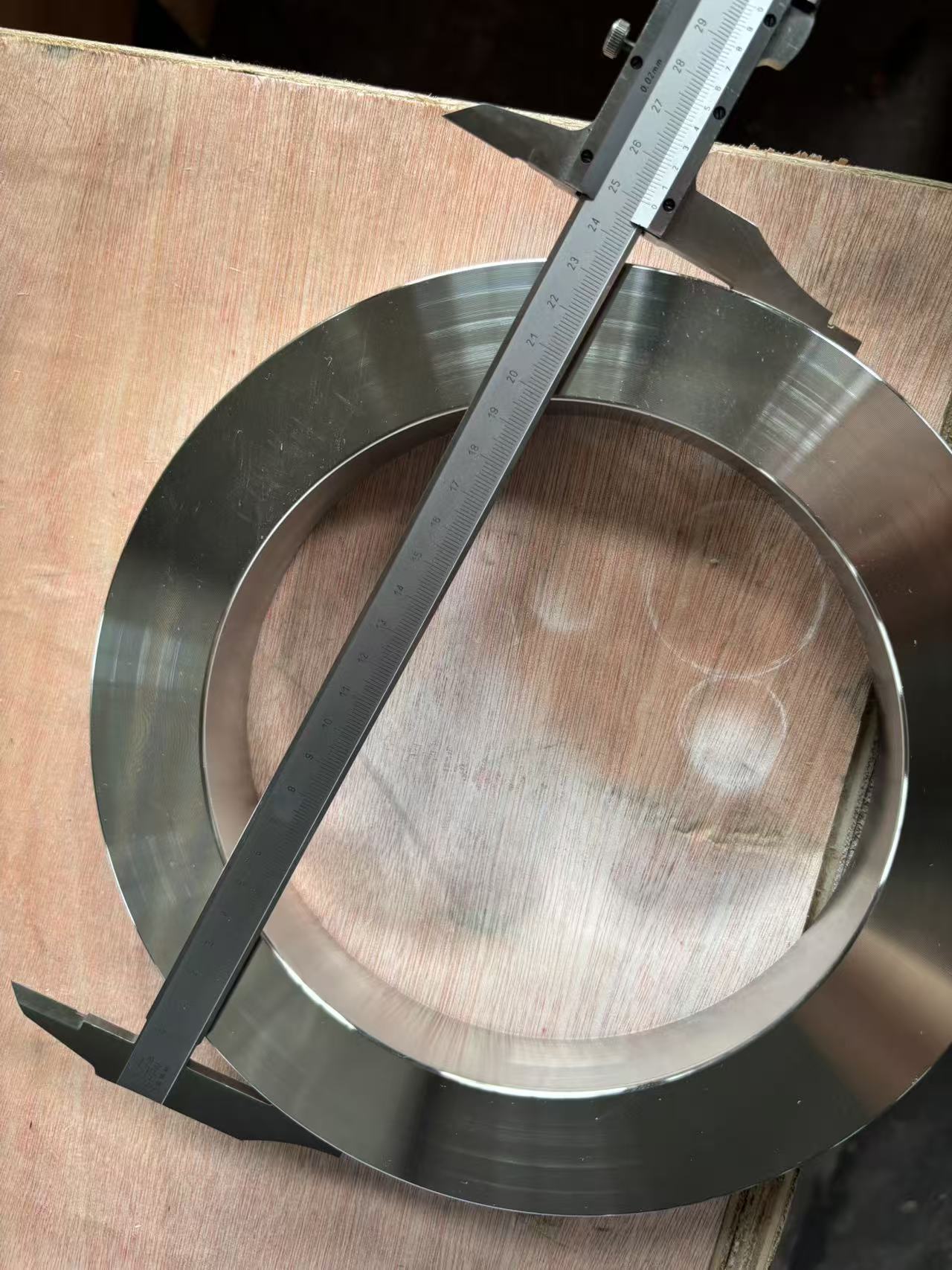
In the fields of offshore oil and gas, chemical processing, seawater desalination and marine engineering, flanges are the joints that hold entire piping systems together. As projects move into higher pressures, corrosive media and safety-critical service, there is a strong demand for flanges that will not fail under load, temperature cycling or chloride attack. For engineers and procurement teams planning to specify flange materials, understanding how forged rings are made and which stainless or duplex grade to choose is a key step to ensuring a reliable connection. This article provides a practical guide to forged rings for flanges, explaining the ring-rolling process, the ASTM A182 stainless and duplex grades, the relevant standards, and where these rings are most effectively used across industries.
Understanding Forged Rings for Flanges
A forged ring for a flange is a seamless, circular preform produced by hot forging and then ring rolling, rather than by casting or by cutting a ring out of plate. The process begins with a solid billet that is heated, upset and pierced to form a hollow ring. That pierced ring is then passed between rotating rolls that expand its diameter and control its wall thickness, producing a dense, seamless blank. After solution annealing and rapid water quenching (for stainless and duplex grades), the ring is machined into the finished flange shape — weld neck, slip-on, blind, socket-weld, threaded or lap-joint.
Because the metal is worked in the solid state, the grain structure is refined and the grain flow follows the contour of the ring — around the bore, across the face and through the hub. That continuous grain flow is what gives forged rings their engineering advantage over cast or cut-plate alternatives, which is why ring rolling is the preferred route for large-diameter weld-neck and blind flanges.
Why Forged Rings Outperform Cast and Cut-Plate Flanges
When you specify flanges for pressure-containing service, the manufacturing method matters as much as the material. Compared with cast flanges and plate-cut rings, forged rings deliver measurable benefits:
- Continuous grain flow: the grain follows the flange contour, so strength is aligned with the direction of applied stress — exactly what a pressure joint needs.
- Fully dense, no porosity: solid-state forging eliminates the gas pores, shrinkage cavities and inclusions that can occur in castings.
- Higher strength: forged stainless components typically show roughly 30% higher tensile strength than their cast equivalents of the same grade.
- Superior fatigue and impact resistance: the refined, uniform structure resists cracking under cyclic pressure and temperature swings.
- Consistent properties batch to batch: controlled forging and heat treatment give predictable mechanical results, which matters for code compliance.
In short, for high-pressure, high-temperature or safety-critical lines, forged rings are the engineering standard — casting and cut-plate options are better reserved for low-pressure, non-critical utility service.
Stainless & Duplex Grades for Forged Rings (ASTM A182)
Super Duplex 2507 pipe & fittings are one part of the duplex story; the same alloy family is also supplied as forged rings and flanges under ASTM A182. The specification covers forged or rolled alloy and stainless steel pipe flanges, fittings, valves and parts, and the grade you choose should match your service environment. The table below summarizes the most common stainless and duplex grades used for forged rings:
| ASTM A182 Grade | UNS | EN / Werkstoff | Family | Best for |
|---|---|---|---|---|
| F304 | S30400 | 1.4301 | Austenitic | General corrosion, water, mild chemical, construction |
| F304L | S30403 | 1.4307 | Austenitic (low C) | Welded structures, tanks, low-to-medium corrosion |
| F316 | S31600 | 1.4401 | Austenitic (+Mo) | Marine, chemical, coastal, process piping |
| F316L | S31603 | 1.4404 | Austenitic low C | Pharma, food, sanitary, welded systems |
| F321 | S32100 | 1.4541 | Ti-stabilized austenitic | High-temperature heat exchangers, thermal equipment |
| F347 | S34700 | 1.4550 | Nb-stabilized austenitic | Refinery, power, high-temperature process |
| F51 (2205) | S31803 | 1.4462 | Duplex | Offshore, desalination, chemical, high-pressure |
| F60 (2205) | S32205 | 1.4462 | Duplex (improved) | Same as F51, tighter composition control |
| F53 (2507) | S32750 | 1.4410 | Super duplex | Severe marine, offshore, high-chloride service |
| F55 | S32760 | 1.4501 | Super duplex (+W) | Subsea manifolds, FPSO, NORSOK / NACE sour |
| F44 (254SMO) | S31254 | 1.4547 | 6Mo super-austenitic | FGD, desalination, crevice-corrosion service |
For duplex and super duplex rings, the ferrite-austenite balance is held in the 35–55% window through post-forge solution annealing and rapid quench. The pitting resistance equivalent number (PREN) rises from roughly 24–26 for 316L, to ~34–35 for 2205, and 40–42+ for 2507 — which is why the super duplex grades are chosen where chlorides are aggressive.
Standards & Specifications for Your Project
Forged rings and flanges are covered by a set of well-established international standards, which makes it straightforward to cross-reference with your project specification:
- ASTM A182 / A182M — forged or rolled stainless and alloy steel flanges, fittings and parts
- ASME B16.5 — pipe flanges and flanged fittings, NPS ½–24, Class 150–2500
- ASME B16.47 — large-diameter steel flanges (Series A and B)
- EN 1092-1 — European flange dimensions and ratings (PN series)
- NACE MR0175 / ISO 15156 — sour (H2S) service; hardness control for duplex grades
- NORSOK M-630 / M-650 — offshore qualification for duplex and super duplex
- PED 2014/68/EU — European pressure-equipment directive for CE marking
Where Forged Stainless & Duplex Rings Are Used
Because forged rings combine dense, reliable structure with the corrosion resistance of stainless and duplex alloys, they are specified across the following industries:
Offshore Oil & Gas
Wellhead connections, subsea manifolds, FPSO topside piping and fire-water systems rely on forged duplex and super duplex rings. They resist chloride pitting, crevice corrosion and sulfide stress cracking, and qualify for sour service under NACE MR0175 — which matters for any hardware exposed to H2S.
Chemical & Petrochemical Processing
Acid, alkali and chlorinated solvent streams, high-pressure reactors and heat exchangers demand both corrosion resistance and structural integrity. Forged 316L, 2205 and 2507 rings are common upgrades where austenitic grades have historically failed in hot chloride service.
Desalination & Seawater Systems
Reverse-osmosis plants, MSF/MED evaporators and seawater-cooled exchangers operate in warm, high-chloride water. The high PREN of 2205 and 2507 forged rings keeps them reliable where carbon steel would corrode and lower alloys would pit.
Marine & Shipbuilding
Ballast-water systems, seawater cooling loops, scrubbers and platform structures benefit from the strength-to-weight advantage of forged rings and their immunity to chloride stress corrosion cracking in warm marine environments.
Power Generation & Flue Gas Desulfurization (FGD)
Steam circuits, boilers, condensers and FGD absorber piping handle high temperature and chloride-laden fluids. Forged rings perform where carbon steel would corrode and where failure is not an option.
Pulp & Paper
Bleach-plant piping and chlorine-dioxide systems expose metal to aggressive halides. The localized-corrosion resistance of duplex forged rings makes them a durable choice for these circuits.
Food, Beverage & Pharmaceutical
Sanitary-grade 316L forged rings with appropriate surface finish meet strict hygiene standards for food, beverage and pharmaceutical piping, where cleanability and traceability are mandatory.
Water Treatment & Mining
From municipal water and wastewater to chloride-leach circuits in hydrometallurgy, forged stainless and duplex rings extend service life in corrosive, high-chloride process streams.
How to Source Quality Forged Rings & Flanges
When you buy forged rings or finished flanges, it is important to evaluate the following aspects with your supplier:
- Mill Test Certificate to EN 10204 3.1 or 3.2, documenting chemistry and mechanical test results
- Solution anneal + rapid water quench (1040–1100 °C for duplex) — no sigma-phase formation
- Positive Material Identification (PMI) to confirm the grade before and after machining
- Ferrite balance of 35–55% (ideally ~45–50%) for duplex and super duplex rings
- Hardness within the NACE limit (e.g. 28 HRC max for sour-service duplex)
- Non-destructive testing — UT, MPI or DPT for higher pressure classes, per project specification
Why Work With Us for Your Forged Rings & Flanges
As a supplier and stockist of piping materials, we provide stainless and duplex forged rings and finished flanges across the full ASTM A182 range so your project team can consolidate sourcing with one partner. Our offerings include:
- Forged stainless & duplex flanges (WN, SO, BL, SW, TH, LJ) to ASTM A182 / ASME B16.5
- Seamless forged ring blanks for large-diameter and custom flange configurations
- Duplex and super duplex grades — F51, F53 (2507), F55 — with NORSOK and NACE documentation
- Stock and custom sizes, with quick access to qualified forges for non-standard dimensions
We focus on supply reliability, full documentation and responsive engineering support rather than claiming forge ownership — which lets us match the right ring grade and form to your specification without single-source lock-in. Whether you need standard stock flanges or custom forged rings for an offshore, desalination or chemical project, our team can help you specify the right grade and deliver with complete certification. To discuss availability, lead time and pricing for your requirement, contact our team for a quote.
Conclusion
When selecting flanges for high-pressure, corrosive or safety-critical service, it is essential to clearly define your material and manufacturing requirements and choose a reliable supplier. Forged rings — especially in stainless and duplex grades under ASTM A182 — offer a strong combination of dense, defect-free structure, aligned grain flow and proven corrosion resistance across offshore, chemical, desalination, marine and power applications. Whether you are specifying 316L for sanitary duty, 2205 for seawater, or 2507 for the most aggressive chlorides, a forged ring is the foundation of a flange you can trust — and the right supply partner will help you specify it with confidence.