
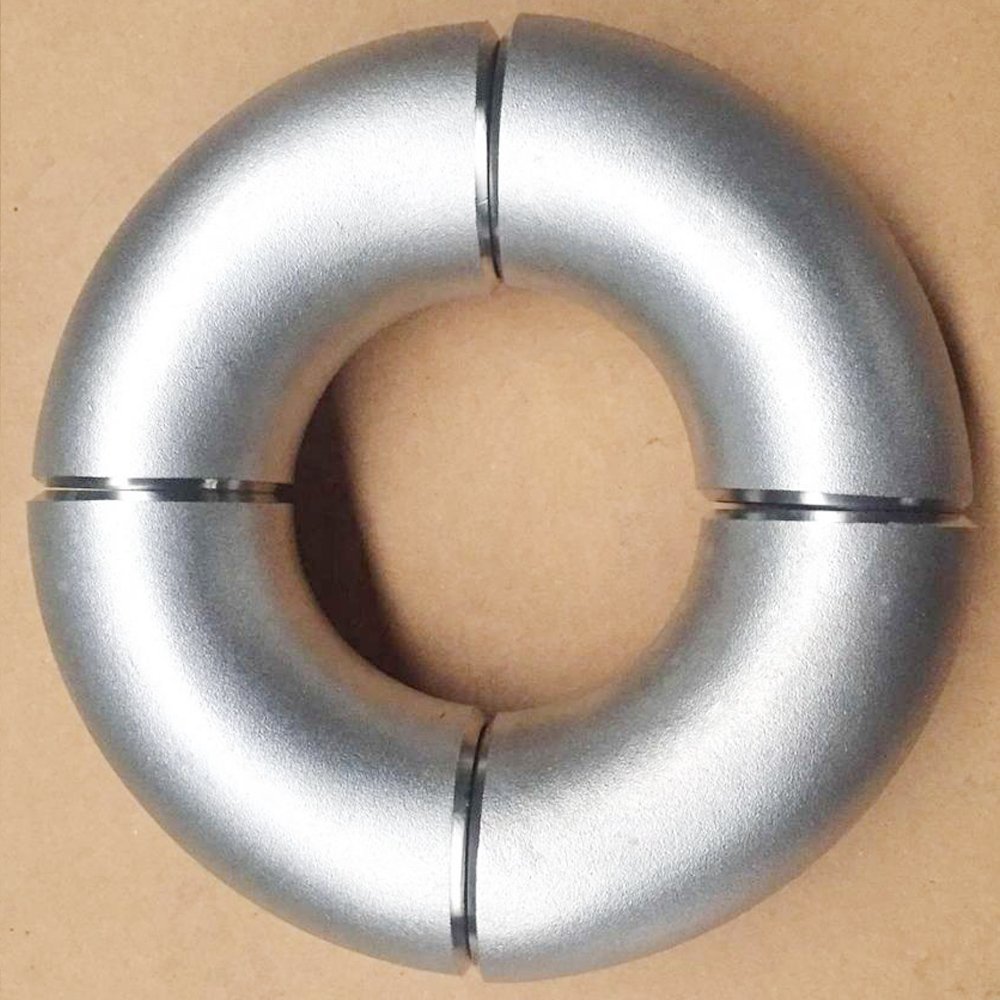
In the fields of offshore oil and gas, seawater desalination, marine engineering and chemical processing, Super Duplex 2507 pipe and fittings play a vital role. As industrial projects move into harsher, chloride-rich and high-pressure service, there is a strong and growing demand for alloys that resist corrosion while carrying high mechanical loads. For engineers and procurement teams planning to specify 2507, understanding its chemical composition, mechanical properties and real-world applications is a key step to ensuring a successful material selection. This article provides a practical guide to Super Duplex 2507 (UNS S32750) pipe and fittings, explaining what the alloy is, its composition and strength, the relevant standards, and where it is most effectively used across industries.
Understanding Super Duplex 2507 (UNS S32750)
Super Duplex 2507 is a nitrogen-enhanced ferritic-austenitic stainless steel with a balanced, roughly 50/50 mix of ferrite and austenite phases. This dual-phase structure is what gives 2507 both the high strength of ferritic grades and the toughness and corrosion resistance of austenitics. Its high chromium, molybdenum and nitrogen content pushes the Pitting Resistance Equivalent Number (PREN = Cr + 3.3×Mo + 16×N) to 40 or above, which is why it is classified as a super duplex grade under NORSOK M-630. Compared with standard Duplex 2205, 2507 carries more chromium, molybdenum and nitrogen, making it suitable for far more aggressive chloride environments and higher mechanical loads. For your project, this means 2507 can often be specified at thinner wall thicknesses than 316L while delivering longer service life in seawater and sour service.
Chemical Composition of Super Duplex 2507
Before specifying 2507, it is essential to clearly understand its chemical composition, because the alloy’s corrosion resistance depends directly on the balance of chromium, molybdenum and nitrogen. The chemistry below follows ASTM A182 Grade F53, ASTM A790/A789 and EN 10088-3 (1.4410). Values are weight percent.
| Element | Composition (wt.%) |
|---|---|
| Carbon (C), max | 0.030 |
| Manganese (Mn), max | 1.20 |
| Silicon (Si), max | 0.80 |
| Phosphorus (P), max | 0.035 |
| Sulfur (S), max | 0.020 |
| Chromium (Cr) | 24.0 – 26.0 |
| Nickel (Ni) | 6.0 – 8.0 |
| Molybdenum (Mo) | 3.0 – 5.0 |
| Nitrogen (N) | 0.24 – 0.32 |
| Copper (Cu) | No intentional addition |
| Tungsten (W) | No intentional addition |
| Iron (Fe) | Balance |
PREN: typically 41–43 (minimum ~40 qualifies the alloy as super duplex). The absence of intentional copper and tungsten is what distinguishes S32750 from the related S32760 (Zeron 100) and S32550 (Ferralium 255) grades.
Mechanical Properties of 2507 Pipe & Fittings
The mechanical properties below are the minimum requirements for solution-annealed material at room temperature, per ASTM A790/A789 (pipe & tube), ASTM A815 (fittings) and ASTM A182 F53 (forgings & flanges). When evaluating a supplier’s mill certificate, these are the values you should verify against your purchase specification.
| Property | Minimum | Typical | Test Standard |
|---|---|---|---|
| Tensile Strength | 795 MPa (115 ksi) | 800 – 1000 MPa | ASTM A370 |
| Yield Strength (0.2% offset) | 550 MPa (80 ksi) | 620 – 720 MPa | ASTM A370 |
| Elongation (in 50 mm) | 15% | 25 – 35% | ASTM A370 |
| Hardness | 32 HRC max | 25 – 28 HRC | ASTM E18 |
| Charpy V-notch at −46°C | 45 J min | 60 – 100 J | ASTM E23 / NORSOK M-630 |
| Ferrite content (base metal) | 35 – 55% | 45 – 50% | ASTM E562 |
Sour-service note: for NACE MR0175 / ISO 15156 service, hardness must be limited to 28 HRC maximum. The strength comes entirely from the duplex microstructure — there is no precipitation hardening or aging step.
Physical Properties of Super Duplex 2507
| Property | Value |
|---|---|
| Density | ~7.8 g/cm³ |
| Melting range | ~1350 – 1400 °C |
| Thermal conductivity (at 100°C) | ~14 – 15 W/m·K |
| Coefficient of thermal expansion | ~12 – 13 µm/m·°C |
| Specific heat | ~460 – 480 J/kg·K |
| Electrical resistivity | ~0.78 µΩ·m |
Maximum recommended continuous service temperature is about 315 °C (600 °F). Prolonged exposure above this range can reduce toughness and corrosion resistance, so 2507 should be limited to applications below 600 °F.
Standards & Specifications for Your Project
Super Duplex 2507 is covered by a wide range of international standards, which makes it straightforward to cross-reference with your project specifications:
- ASTM A790 — seamless and welded 2507 pipe
- ASTM A789 — seamless and welded 2507 tube
- ASTM A815 — 2507 butt-weld fittings
- ASTM A182 Grade F53 — 2507 forged fittings and flanges
- ASTM A240 / A276 / A479 — plate, bar and shapes
- EN 1.4410 (X2CrNiMoN25-7-4) — European designation
- NACE MR0175 / ISO 15156 — sour (H2S) service
- NORSOK M-630 / M-650 — offshore qualification
- API 6A / API 17D — wellhead and subsea equipment
Why Upgrade to 2507 From 2205 or 316L
| Grade | PREN | Yield (min) | Tensile (min) | Best for |
|---|---|---|---|---|
| 316L | ~24–26 | ~170 MPa | ~485 MPa | Mild corrosion, general service |
| Duplex 2205 (S31803) | ~34–35 | 450 MPa | 620 MPa | Moderate chloride, cost-sensitive |
| Super Duplex 2507 | 40–42+ | 550 MPa | 795 MPa | Aggressive chlorides, high pressure |
In short: 2507 delivers roughly double the yield strength of 316L and a meaningfully higher PREN than 2205, at a fraction of the cost of nickel-base alloys such as 625. That is why engineers reach for it when 2205 is no longer enough but a full nickel alloy cannot be justified.
Where Super Duplex 2507 Pipe & Fittings Are Used
Because of its high PREN and proven performance in chloride service, 2507 pipe and fittings are widely used across the following industries:
Offshore Oil & Gas
Seawater injection lines, produced-water systems, subsea manifolds, topside process piping and fire-water systems all rely on 2507 because of its resistance to chloride pitting, crevice corrosion and sulfide stress cracking. It is qualified for sour service under NACE MR0175, which matters for wellhead and subsea hardware.
Desalination & Seawater Systems
Reverse-osmosis (RO) plants, MSF/MED evaporators, seawater intake and brine-discharge lines, and seawater-cooled heat exchangers use 2507 extensively. Its high PREN and critical pitting temperature (CPT ≥ 50 °C per ASTM G48) keep it reliable in warm, high-chloride seawater.
Chemical & Petrochemical Processing
For organic-acid production, acidic chloride streams, heat exchangers and pressure vessels, 2507 resists both uniform and localized corrosion. It is a common upgrade where 316L or 2205 have historically failed in hot chloride service.
Marine & Shipbuilding
Ballast-water systems, seawater cooling loops, scrubbers and offshore-platform structures benefit from 2507’s strength-to-weight advantage and immunity to chloride stress corrosion cracking in warm marine environments.
Pulp & Paper
Bleach-plant piping, chlorine-dioxide systems and liquor oxidizers expose metal to aggressive halides. 2507’s localized-corrosion resistance makes it a durable choice for these circuits.
Power Generation & Flue Gas Desulfurization (FGD)
Cooling-water systems and FGD absorber piping in power plants handle chloride-laden liquids and flue gases. 2507 performs where carbon steel would corrode and austenitics would pit.
Mining & Hydrometallurgy
Chloride-leach circuits, heap-leach and pregnant-leach solutions are highly corrosive. 2507 pipe and fittings extend service life in these aggressive, high-chloride process streams.
How to Source Quality Super Duplex 2507 Pipe & Fittings
When you buy 2507 pipe and fittings, it is important to evaluate the following aspects with your supplier:
- Mill Test Certificate to EN 10204 3.1 or 3.2, with verified Cr/Ni/Mo/N chemistry
- Solution anneal + rapid water quench (1040–1100 °C) — no sigma-phase formation
- Ferrite balance of 35–55% (ideally ~45–50%) confirmed by ferrite measurement
- CPT testing per ASTM G48 (Method E) for seawater/offshore service
- Hardness within the 28 HRC limit for sour-service compliance
Why Work With Us for Your Super Duplex 2507 Pipe & Fittings
As a supplier and stockist of piping materials, we provide Super Duplex 2507 across the full product range so your project team can consolidate sourcing with one partner. Our 2507 offerings include:
- Butt-weld 2507 fittings (elbows, tees, reducers, caps, stub ends) to ASTM A815
- Seamless and welded 2507 pipe & tube to ASTM A790 / A789
- Forged threaded and socket-weld fittings and 2507 flanges to ASTM A182 F53
- Stock and custom sizes, with quick access to qualified mills for non-standard dimensions
We focus on supply reliability, full documentation and responsive engineering support rather than claiming mill ownership — which lets us match the right 2507 product form to your specification without single-source lock-in. Whether you need standard stock sizes or custom 2507 pipe, fittings and flanges for an offshore, desalination or chemical project, our team can help you specify the right forms and deliver with complete certification. To discuss availability, lead time and pricing for your requirement, contact our team for a quote.
Conclusion
When selecting pipe and fittings for chloride-rich, high-pressure or sour service, it is essential to clearly define your material requirements and choose a reliable supplier. Super Duplex 2507 (UNS S32750) offers a strong combination of high strength, excellent pitting and crevice corrosion resistance, and proven performance across offshore, desalination, chemical and marine applications. Whether you are upgrading from 316L, moving beyond 2205, or qualifying material for sour service, 2507 is a grade worth specifying — and the right supply partner will help you do it with confidence.